Showing posts with label Dystopian literature. Show all posts

Saturday, May 23, 2015

Another Dystopian Trilogy, part 1


http://en.wikipedia.org/wiki/Margaret_Atwood
In Oryx and Crake, Margaret Atwood writes a stark future. She herself refers to the genre as "speculative fiction" ~ meaning, in her definition, that it could happen. Not that it will. Some have referred to Oryx and Crake as science fiction; others as horror. My personal preference? Dystopian. One view of what the world may look like if we continue our self-destructive, and/or earth-destructive, path.

One element of the novel that fascinates me the most is that it takes place entirely in the life and mind of the main character and narrator, Snowman. Oryx and Crake are both figments of his memory and imagination. As his memories tumble forth, so do the characters develop. Atwood's clarity of style makes this work.

There remains a frightening element to this book even though it was published over a decade ago, in 2003. Much of what is intimated as causing the global devastation (overpopulation, destruction of species, blithe separation of the wealthy and those without less or no access to wealth, lack of a true moral compass, etc.), continues to bounce us forward to this day. Other causes (genetic and bio-engineering of new species of everything from animals to plants to viruses and cures, etc.) remain firmly in the speculative arena, yet tug the reader toward the sense that they are possibly happening.

I'm currently in the midst of the second in the series, The Year of the Flood. The title flood is a waterless flood, more of a vast barren wasteland. I'll continue the tale when I finish the story.

What do you speculate will the future look like? What do you see happening now that causes you to fear? What causes you to hope? How can you affect change in one direction or the other?

Wednesday, November 20, 2013

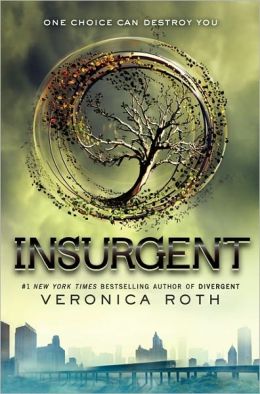
Insurgent


from the teaser:
"One choice can transform you - or it can destroy you. But every choice has consequences, and as unrest surges in the factions all around her, Tris Prior must continue trying to save those she loves - and herself - while grappling with haunting questions of grief and forgiveness, identity and loyalty, politics and love."


Insurgent is the second book of the Divergent trilogy. It picks up the story at the precise point where Divergent left off.... and it continues with Tris struggling to be true to herself as she's finding out more about who and what she is. This seems to be a common theme in dystopian literature. Another theme is that it's the young who will save and provide safety for the world as it will be in the future. The youth take on seriously adult roles, make very tough decisions and fight incredible odds to survive. When things are really, really bad, the youth are the only ones who can lead and fight through to a better tomorrow ~ even if it's only minimally better.

Why is dystopian literature so popular? What is it about a world in pieces, being pieced back together by youth, that fascinates us so much?

Monday, November 11, 2013

Gathering Blue


from Wikipedia:
The central character, Kira, who has a twisted leg, is orphaned and must learn to survive in a society that normally leaves the weak or disabled exposed to die in the fields. In Gathering Blue, Kira needs a reason for the Council of Edifice to keep her in the village and not take her to the Field (which is certain death at the hands of The Beasts). Kira has a gift for embroidery, and the Council keeps her around to mend and update a beautiful robe that shows the history of their society. In the course of the book, she begins to learn the art of dyeing thread different colors, except for blue, which nobody in her community knows how to make. She also learns the truth of her village and the terrible secrets they hold.


Gathering Blue is the sequel to The Giver. There are more communities with different sets of rules and ways of being in the world created by Lois Lowry. Kira is orphaned, her father being killed by The Beasts when she was barely born; her mother through getting ill. Kira is strong-willed, yet has no one to speak for her. This story of a young girl discovering and uncovering her way through an often duplicitous world captures most people who read it. The created world is fraught with dangers.

Why read about dangerous worlds where innocence is challenged by power? Why are so many young people drawn to this story?

Sunday, November 10, 2013

Divergent


The 'teaser' from the book:
In Beatrice Prior's dystopian Chicago world, society is divided into five factions, each dedicated to the cultivation of a particular virtue-Candor (the honest), Abnegation (the selfless), Dauntless (the brave), Amity (the peaceful), and Erudite (the intelligent). On an appointed day of every year, all sixteen-year-olds must select the faction to which they will devote the rest of their lives. For Beatrice, the decision is between staying with her family and being who she really is-she can't have both. So she makes a choice that surprises everyone, including herself.


Divergent is the latest rage in young adult dystopian fiction. It's written from a first-person point of view ~~ and that 'first-person' is 16-year-old Beatrice Prior. She talks through every thought and feeling she has. Throughout the story, we know everything she knows about herself. All of this makes her feel incredibly real to us.

On the testing day, before the chosing of the faction, Beatrice is told she is Divergent. She doesn't fit into any one particular Faction... she fits into multiple Factions. She has no clear idea what this means... and that takes her places she never would have thought she'd go.

Why are young people reading this kind of fiction? What's so striking about Beatrice Prior? or the world she lives in?

Saturday, November 9, 2013

Dystopian Literature, The Giver

The Giver by Lois Lowry
Jonas's world is perfect. Everything is under control. There is no war or fear of pain. There are no choices. Every person is assigned a role in the community. When Jonas turns 12 he is singled out to receive special training from The Giver. The Giver alone holds the memories of the true pain and pleasure of life. Now, it is time for Jonas to receive the truth. There is no turning back.


The first dystopian labeled novel I read and discussed with my young daughter was The Giver. It now stands as one of the classics read and discussed in many 6th or 7th grade classrooms. The reading of it is easy; the understanding and content, not quite as much.

Jonas' world is controlled, safe, predictable. Families consist of people chosen to be together and young who are determined to be with the Nurturer parent. Jonas doesn't feel ready for the upcoming Ceremony of Twelve where he and those of his age will receive their community jobs/roles. Jonas becomes the Receiver ~ a role that only one person in a generation is ever assigned because that person carries forward the memories of the entire community. As he receives the memories from the Giver, he finds that his safe and comfortable world is really very dull.

Why would The Giver be read by 11- and 12-year-olds? What lessons could they learn about their world from reading about Jonas and his?

Sunday, September 29, 2013

Dystopian Literature, Introduction

from http://en.wikipedia.org/wiki/Dystopian_literature:
The utopia and its offshoot, the dystopia, are genres of literature that explore social and political structures. Utopian fiction is the creation of an ideal society, or utopia, and the setting for a novel. Dystopian fiction is the opposite: creation of an utterly horrible or degraded society, or dystopia. many novels combine both, often as a metaphor for the different directions humanity can take in its choices, ending up with one of two possible futures. Both utopias and dystopias are commonly found in science fiction and other speculative fiction genres, and arguable are by definition a type of speculative fiction.
One thing I've observed over the years of raising a daughter to college age, is that dystopian literature is very much alive and a distinctly strong choice of reading for many young adults. The first one we read together was Lois Lowry's book The Giver. My daughter was perhaps in fourth or fifth grade. We read it together, went to a gathering with Lois Lowry, and later saw the world premier of the play.

The Giver is the beginning of a trilogy of a very different sort. Usually in trilogies, the timeline is nearly, if not perfectly, continuous from one volume to the next; but in Lowry's books, time passes between each of the volumes: The Giver, Gathering Blue and Messenger. In each of them, someone important gets injured or dies. That's one of the features of dystopian young adult literature. The young people who are the focal points of the novels go through tremendous losses ~ and still find reasons and the means to hope.
Have you read these novels? What do you think of them?