Showing posts with label Divergent. Show all posts

Saturday, March 28, 2015

The 100


For the past several days, I've bean watching episodes of the dystopian TV show The 100. The online description:
When nuclear Armageddon destroys civilization on Earth, the only survivors are those on the 12 international space stations in orbit at the time. Three generations later, the 4000 survivors living on a space ark of linked stations see their resources dwindle and face draconian measures established to ensure humanity's future. Desperately looking for a solution, the arks leaders send 100 juvenile prisoners back to the planet to test is habitability. Having always lived in space, the exiles find the planet fascinating and terrifying, but with the date of the human race in their hands, they must forge a part into the unknown.
Fascinating prospects. I'm amazed at the continued creativity. Dystopian stories are a significant genre in recent years: the Hunger Games and Divergent series, to name two of the most popular. One thing this show has that the others miss is some level of specificity as to what created the altered future. This one clearly states that it was a nuclear war. Like others of this genre, there is an element of outside control ostensibly for the good of all. Yet in this one, that force has no inherent evil or hunger for power. It's more of an established mythos of who and what they are.

Another difference is the element of colonization and encountering unknown others who are similar yet different, infused with their own sense of how things should be. It takes the confrontation to a level that is not only internal, but inter-relational. The leaders, as with Hunger Games and Divergent, are young, flawed and adaptable.

I've written previously about dystopian literature. I like the genre. The stories have been around for a long time, showing up lately with more frequency. It seems to be a creative response ~ as the preceding books were ~ to the strong sense of destruction that permeates so much of our society today, including global warming, economic disparity, state-sponsored torture and military excesses.

Have you read or watched dystopian stories? Which ones? How does the genre affect you? What else do you see happening in response to the difficulties and destructive forces in our society?


Tuesday, March 10, 2015

Vertigo


Vertigo is the conflict between the fear of falling and the desire to fall.
~ Salman Rushdie

When I read this sentence, my first thought was: "What's Rushdie doing inside my head?"

I remember trips up to the 94th floor of the John Hancock Building in Chicago to look out over the city. Wow! I loved it up there. I flattened myself against the window to look as straight down as I could. The height was impressive and the view incredible. More than that, I felt an incredible draw to going down ~~ not suicidal, by any stretch of the imagination, simply wanting to feel the rush of air slipping past me.

That was one of the things I enjoyed reading Divergent by Suzanne Collins: the zip line from the top of the John Hancock Building down. The description of the feeling of flying. Amazing.

I doubt that I am in any way fearless. I trust the glass that stands between me and falling. That's the reason I understand Rushdie's statement about vertigo. It's a totally different feeling when there's glass holding me in and when there's nothing but air. I've felt that on the Cliffs of Moher in Ireland, in the American Eagle at Six Flags Great America, atop the oddly rippling Great Wall of China or at the window of a Maine lighthouse. The height isn't important. It's the irrational desire to fly.

How do you feel from a height looking down? What feels different if you're safely inside a windowed room looking down? What feels the same? What high place would you like to visit? Why?

Wednesday, November 20, 2013

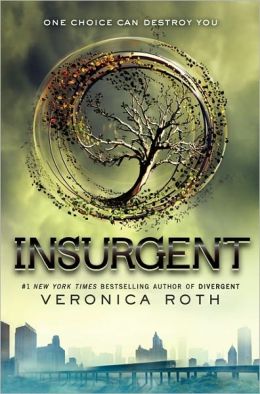
Insurgent


from the teaser:
"One choice can transform you - or it can destroy you. But every choice has consequences, and as unrest surges in the factions all around her, Tris Prior must continue trying to save those she loves - and herself - while grappling with haunting questions of grief and forgiveness, identity and loyalty, politics and love."


Insurgent is the second book of the Divergent trilogy. It picks up the story at the precise point where Divergent left off.... and it continues with Tris struggling to be true to herself as she's finding out more about who and what she is. This seems to be a common theme in dystopian literature. Another theme is that it's the young who will save and provide safety for the world as it will be in the future. The youth take on seriously adult roles, make very tough decisions and fight incredible odds to survive. When things are really, really bad, the youth are the only ones who can lead and fight through to a better tomorrow ~ even if it's only minimally better.

Why is dystopian literature so popular? What is it about a world in pieces, being pieced back together by youth, that fascinates us so much?

Sunday, November 10, 2013

Divergent


The 'teaser' from the book:
In Beatrice Prior's dystopian Chicago world, society is divided into five factions, each dedicated to the cultivation of a particular virtue-Candor (the honest), Abnegation (the selfless), Dauntless (the brave), Amity (the peaceful), and Erudite (the intelligent). On an appointed day of every year, all sixteen-year-olds must select the faction to which they will devote the rest of their lives. For Beatrice, the decision is between staying with her family and being who she really is-she can't have both. So she makes a choice that surprises everyone, including herself.


Divergent is the latest rage in young adult dystopian fiction. It's written from a first-person point of view ~~ and that 'first-person' is 16-year-old Beatrice Prior. She talks through every thought and feeling she has. Throughout the story, we know everything she knows about herself. All of this makes her feel incredibly real to us.

On the testing day, before the chosing of the faction, Beatrice is told she is Divergent. She doesn't fit into any one particular Faction... she fits into multiple Factions. She has no clear idea what this means... and that takes her places she never would have thought she'd go.

Why are young people reading this kind of fiction? What's so striking about Beatrice Prior? or the world she lives in?